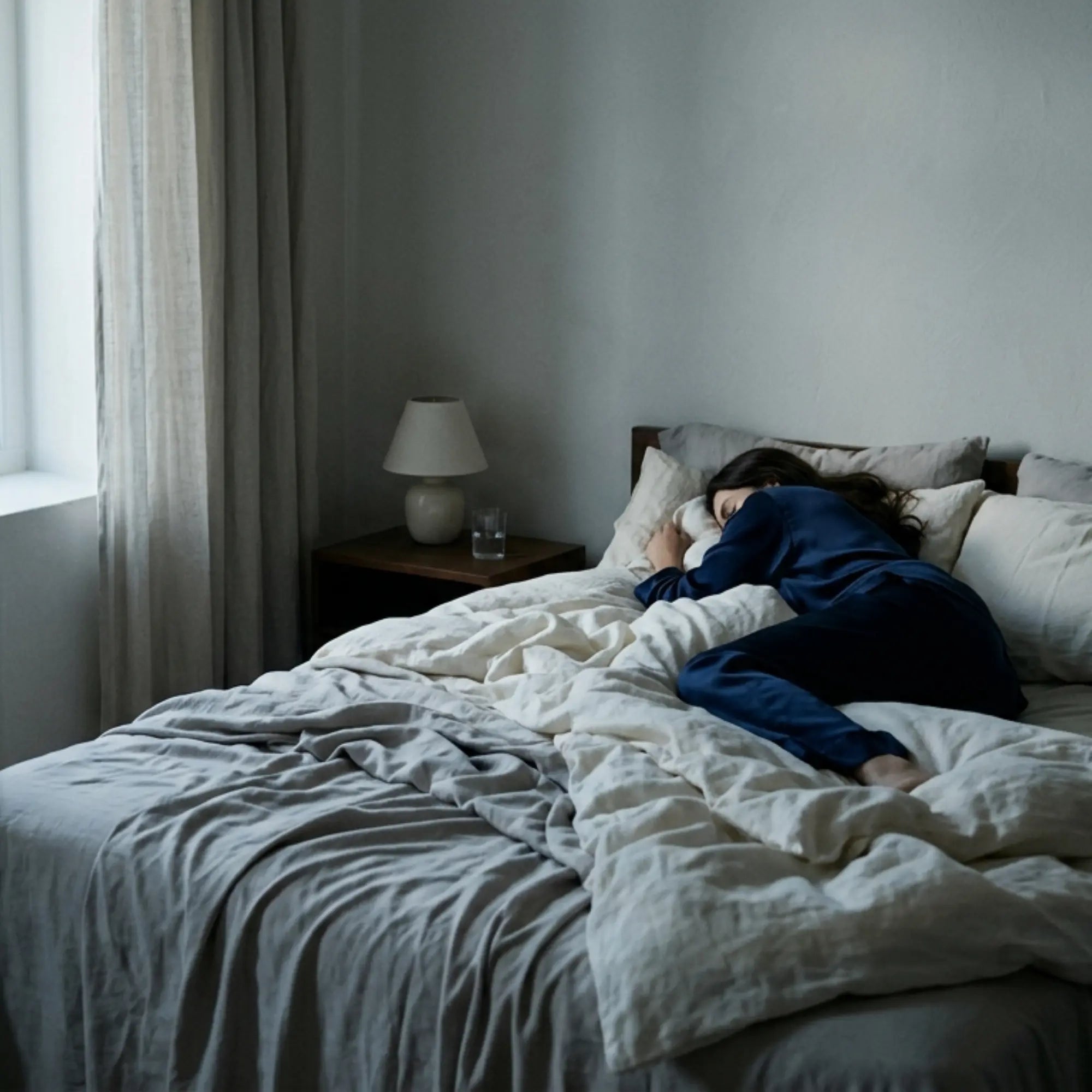
Why do we wake up between 3 and 5 am? (and how to get back to deep sleep)
It's 3:47 AM.
The night is silent, yet you're awake.
For no apparent reason.
Without a sound.
Without light.
And often, it happens repeatedly.
Always at the same time.
Waking up between 3 AM and 5 AM is a frequent experience — and rarely insignificant.
This time corresponds to a fragile balance of sleep, where the body becomes more sensitive to its environment… and to itself.
Why do we wake up between 3 AM and 5 AM?
This awakening corresponds to a particular phase of the sleep cycle.
1. A natural sleep transition
Between 3 AM and 5 AM, the body gradually exits deep sleep.
Sleep becomes lighter.
The brain approaches wakefulness.
The slightest stimulus can be enough to cause an awakening.
2. A variation in body temperature
During the night, body temperature drops, then begins to rise again.
This can lead to:
- a sensation of warmth
- discomfort
- micro-awakenings
In this context, the choice of materials becomes essential.
As we explain in our article on suitable nighttime materials, certain fibers allow for better thermal regulation.
→ Feeling hot at night: what material to choose for better sleep?
3. Reappearing mental activity
At this hour, the mind is no longer completely at rest.
Thoughts can return:
- concerns
- anticipation
- diffuse tension
4. A precise biological clock
The body follows a stable internal rhythm.
If this awakening repeats:
- it is memorized
- it becomes anticipated
Why do we always wake up at the same time?
This phenomenon is linked to the circadian rhythm.
The body functions according to a clock influenced by:
- light
- habits
- lifestyle
If an awakening repeats, it becomes a natural point of passage during the night.
What to do when you wake up at night?
The goal is not to force sleep, but to let the body regain its rhythm.
At that moment, certain reflexes can further disrupt the balance:
- checking the time
- picking up your phone
- creating tension
Conversely, simple gestures are often enough:
- slowing down
- breathing
- remaining still
In most cases, the body falls back asleep naturally.
The environment plays a key role
At this precise moment of the night, the body becomes particularly sensitive to its surroundings.
A material that is too warm.
A sensation of humidity.
Unpleasant contact.
These details, sometimes imperceptible at the beginning of the night, become crucial.
Creating a more appropriate environment — more breathable, softer — can transform these awakenings.
The role of the evening ritual is also essential in this transition.
Should what you wear at night be adapted?
Yes. In some cases, adapting what you wear at night can improve comfort.
A lighter, more fluid material allows for:
- temperature regulation
- reducing sensations of warmth
- accommodating body movements
The choice is not just a matter of habit, but of sensation.
We discuss this point in more detail in our dedicated articles:
→ Sleeping with or without pajamas: what to choose?
→ What pajamas to choose when it's hot?
Finding continuity in the night
Waking up between 3 AM and 5 AM is not a malfunction.
It is often a sign of:
- lighter sleep
- an environment to adjust
- or an inner rhythm to calm
With a few subtle adjustments, the night regains its balance.
And sleep, its continuity.
In summary
Waking up at night is natural.
Falling back asleep easily is essential.
Understanding these awakenings allows for appropriate action,
without tension.
To extend this moment
Certain materials more naturally accompany the body when the temperature varies during the night.
This is notably why Maison CÉTOILE has chosen natural silk and TENCEL™ Lyocell as foundational materials: two textures designed to create a more breathable, more fluid, calmer environment throughout the night.
To learn more
If nocturnal awakenings become frequent, other factors can also influence sleep quality: evening habits, materials in contact with the skin, or the perceived temperature during the night.
→ Why an evening ritual improves sleep?