Washed linen bedding: advantages, disadvantages, and tips for choosing the right one
A natural material with a lively texture, washed linen immediately brings a special presence to the bedroom. Its soft feel, slightly wrinkled appearance, and ability to evolve with use make it a highly valued material for bed linen.
However, washed linen does not necessarily meet everyone's expectations. Its less smooth appearance compared to cotton, its generally higher price, and the care required for its maintenance must also be taken into consideration.
So, what are the real advantages and disadvantages of washed linen bed linen? What fabric weight should you choose, and how do you recognize a quality material? Here are the main points to know before making your choice.
What is washed linen?
Linen is a natural fiber extracted from the stem of the flax plant. After harvest, several steps are necessary to separate, prepare, and transform the fibers before they are spun and woven.
The term "washed linen" does not refer to a specific variety of flax. It refers to a treatment performed on the finished fabric to soften it and give it a more relaxed feel from the very first uses.
This treatment also reveals the characteristic look of linen: a matte surface, a slightly irregular texture, and a natural wrinkle that does not aim to be perfectly uniform.
Washed linen thus distinguishes itself from new linen, which is stiffer or more heavily finished. It offers a softer feel from the start, while generally continuing to soften with each wash.
What are the advantages of washed linen bed linen?
A soft feel and a lively texture
Washed linen does not have the perfectly smooth feel of cotton sateen or silk. Its uniqueness lies precisely in its tangible texture and the way the material interacts with light.
This surface gives the bed a natural, relaxed look. Creases are not considered defects to be hidden, but rather a component of linen’s aesthetic.
The experience, however, depends on the quality of the fibers, the weave, the fabric weight, and the washing process used. Two sets of bed linen both labeled "100% washed linen" can therefore offer very different feels.
A material pleasant throughout the seasons
Linen is appreciated for its ability to absorb moisture and allow it to evaporate gradually. In bed linen, this characteristic can help maintain a more comfortable feeling when temperatures vary during the night.
In summer, it often feels drier and lighter to the touch. During cooler periods, it remains pleasant when paired with a duvet and layers adapted to the room's temperature.
It is, however, better to speak of textile comfort rather than promising perfect temperature regulation. The sensation also depends on the fabric weight, the duvet, the mattress, the ambient humidity, and each person's sensitivity.
A material that softens over time
Quality linen bed linen is designed to withstand many cycles of use and washing. The material can gradually become softer without losing the texture that gives it its character.
This evolution is one of linen's attractions: it does not seek to remain fixed in its original appearance. It develops a patina, softens, and gradually settles into the bedroom.
To preserve this evolution, it remains essential to follow the care recommendations and avoid overly aggressive treatments.
Natural elegance, with no ironing required
Washed linen is particularly suitable for those who appreciate an elegant bed but do not want a perfectly taut surface.
After washing, it can be dried with care, reshaped, and put on the bed without ironing. Its natural wrinkles create an atmosphere that is softer and less formal than perfectly smooth linen.
This apparent simplicity does not mean the bed lacks structure. A well-fitted bottom sheet, a properly sized duvet cover, and harmoniously arranged pillowcases allow for a balanced ensemble.
A material easy to combine in the bedroom
Thanks to its matte and textured appearance, washed linen easily dialogues with wood, stone, wool, cotton, and natural fibers.
White or ivory linen can provide light without making the bedroom feel cold, provided it is accompanied by warm materials and a few contrasting details. Natural shades particularly highlight the fabric's texture and the variations of light throughout the day.
To discover this material in a soft and luminous white, explore our collection of French washed linen bed linen.

What are the disadvantages of washed linen bed linen?
Its wrinkled appearance does not appeal to everyone
Washed linen naturally retains creases and slight irregularities. For some, this texture embodies its elegance. For others, it can give the impression of a bed that is less neat than one with cotton percale or sateen.
If you are looking for a very smooth, shiny, and perfectly regular surface, washed linen will likely not be the most suitable material.
Its feel is different from cotton or silk
Even when washed, linen retains a more pronounced tactile presence. It may feel less soft on first contact than cotton sateen or very smooth silk.
This sensation does not necessarily mean the fabric is uncomfortable or of poor quality. It is intrinsic to the very nature of the fiber. The feel then tends to soften with use and washing.
People who are very sensitive to textures should therefore take this criterion into account before choosing a complete set.
Its price is generally higher
The cultivation of flax, the transformation of its stem into textile fibers, and the various stages of spinning, weaving, and tailoring all contribute to its price.
The cost also depends on the origin of the fiber, its quality, the fabric weight, the finishes, and production volumes. A high price, however, is not a guarantee of quality on its own.
It must be accompanied by precise information on composition, the stated origin of the fiber, fabric weight, construction, and care advice.
Its maintenance requires some precautions
Linen generally withstands repeated washing well when cared for according to the manufacturer's recommendations. However, it is best to avoid excessive temperatures or spin cycles, harsh whitening products, and overloading the drum.
During the first few washes, a slight release of fibers may occur. It is best to wash pieces separately or with similar colors, then shake them out before drying.
Air drying helps preserve the fiber. If the dryer is permitted by the label, choose a low temperature and remove the linen before it is completely bone-dry.
What fabric weight to choose for linen bed linen?
The fabric weight, expressed in grams per square meter, indicates the weight of the fabric. It does not, on its own, allow one to judge the quality of bed linen, but it influences its drape, suppleness, and feel.
A relatively light linen will generally produce a more airy and fluid material. A higher fabric weight will provide more density and presence.
There is no universally ideal fabric weight. The right choice depends on the intended use, the season, the desired feel, and the fabric's construction.
For bed linen used throughout the year, a balanced weight allows one to maintain the softness of the linen while ensuring sufficient body. The quality of the fibers and the weave, however, remain just as important as the number indicated.
The Éveil Blanc collection by Maison CÉTOILE is crafted from linen grown in France at 150 g/m², chosen for its balance between lightness, suppleness, and the presence of the material.

Washed linen or cotton: which material to choose?
Washed linen and cotton can both be suitable for bed linen, but they do not offer the same experience.
Washed linen distinguishes itself by its texture, its naturally wrinkled look, and its evolution over time. It will particularly suit those who are looking for a lively, matte, and casual material.
Cotton percale generally has a smoother, cooler, and slightly crisp feel. Cotton sateen offers a surface that is softer, more fluid, and sometimes slightly shiny.
The choice therefore depends less on an absolute hierarchy than on the desired experience:
-
choose washed linen for its texture, character, and natural elegance;
-
choose percale for a cleaner, cooler, and more regular feel;
-
choose cotton sateen for a smoother and more enveloping sensation.
It is also possible to combine several materials in the same bedroom, for example by using a linen set with a textured cotton throw or a lightweight wool blanket.
How to recognize quality linen bed linen?
Several elements allow you to evaluate bed linen before purchasing.
Check the composition
The mention "100% linen" must clearly appear. Terms simply evoking a "linen effect" or "linen look" do not guarantee that the fabric is actually composed of this fiber.
Precisely identify the stated origin
The expressions "French linen," "grown in France," "woven in France," and "made in France" do not mean the same thing.
A transparent brand must specify whether the information refers to the cultivation of the fiber, its weaving, or the construction of the finished product. At Maison CÉTOILE, we specify precisely that the linen in the Éveil Blanc collection is grown in France.
Examine the fabric weight and density
The fabric weight provides an indication of the material's presence, but it must be interpreted alongside the quality of the yarn and the weave.
A heavier fabric is not automatically better. Correctly woven linen with well-selected fibers can offer suppleness, body, and resistance all in a moderate weight.
Observe the finishes
The regularity of the seams, the sturdiness of the corners, the quality of the buttons, the topstitching, and the precision of the dimensions all contribute to the durability of the bed linen.
These details are particularly important for a duvet cover or a fitted sheet, which are subjected to frequent handling and washing.
Read the care advice carefully
Precise instructions demonstrate good knowledge of the material. They also allow you to verify whether the product truly fits your daily life.
Exceptional bed linen should be something that can be used, washed, and enjoyed, not just admired.
How to care for your washed linen bed linen?
Always start by consulting the specific product label. In general, a few simple steps will help preserve the linen:
-
wash pieces inside out or separately during the first cycles;
-
choose a mild detergent and use a moderate amount;
-
avoid harsh whitening agents;
-
do not overload the drum;
-
opt for a moderate spin cycle;
-
shake and reshape the linen after washing;
-
favor air drying whenever possible;
-
avoid over-drying the fiber.
Ironing is not essential if you appreciate the naturally wrinkled look of washed linen. If you prefer a smoother finish, iron the fabric while it is still slightly damp, following the temperature indications.
How to integrate white linen bed linen into the bedroom?
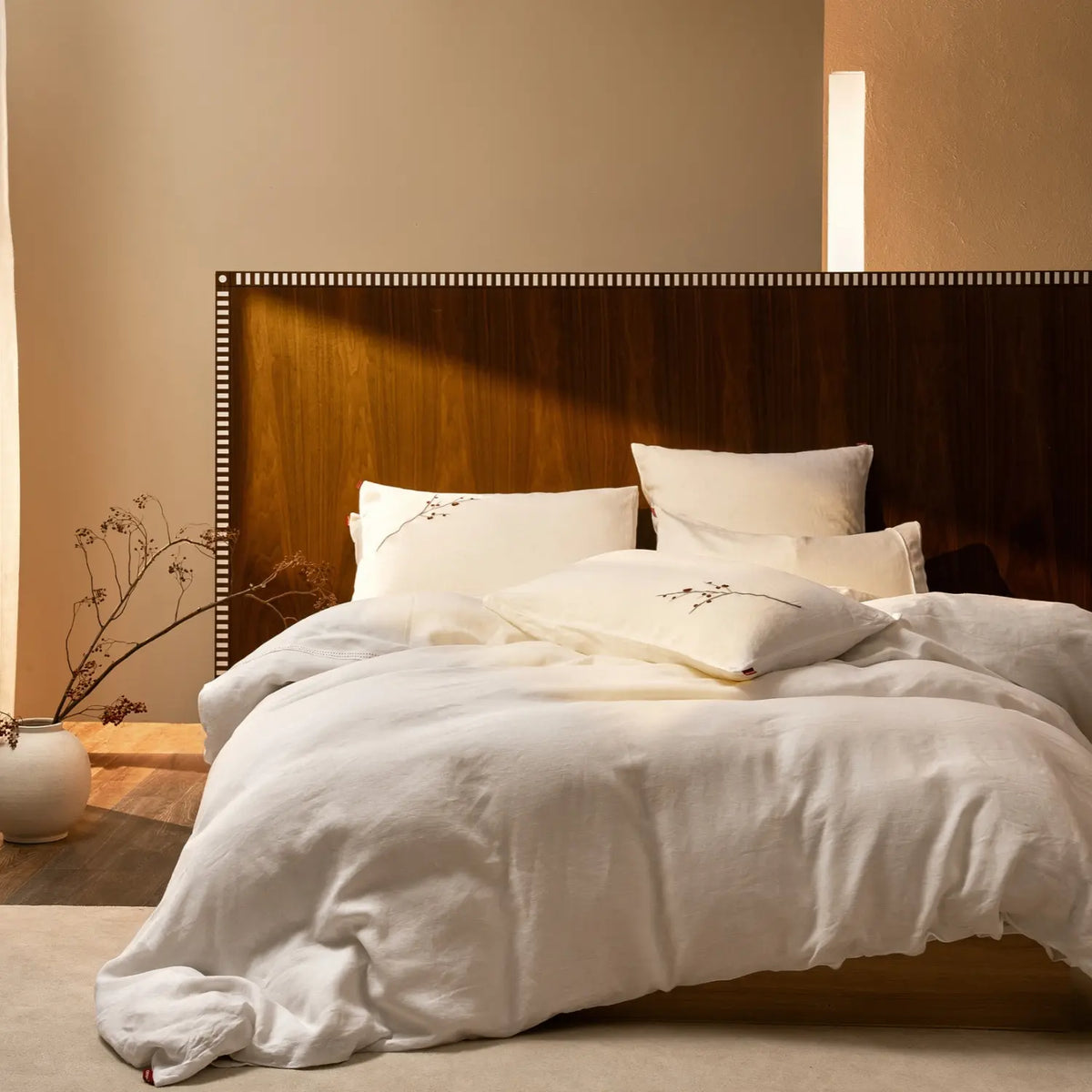
White highlights the texture of the linen and naturally reflects light. To avoid a room that feels too cold, pair it with materials that offer more relief: light or dark wood, wool, ceramic, stone, waffle cotton, or braided fibers.
A few contrasts are enough to structure the whole:
-
a headboard in wood or fabric;
-
a textured throw placed at the foot of the bed;
-
cushions in shades of beige, sage, terracotta, or deep blue;
-
warm, indirect lighting;
-
objects in ceramic or slightly tinted glass.
White then becomes a backdrop rather than an absence of color. It allows textures, volumes, and details to express themselves.
With Éveil Blanc, Maison CÉTOILE has chosen a soft white, punctuated with a signature double red topstitch. A discreet way to introduce an accent into a luminous and peaceful bedroom.
Is washed linen bed linen right for you?
Washed linen can be an excellent choice if you are looking for:
-
a natural material with a visible texture;
-
an elegant bed with no overly formal appearance;
-
a feel that evolves with each wash;
-
a bedroom built around simple and lively materials.
a fabric that is pleasant throughout different seasons;
It may be less suitable if you prefer a perfectly smooth fabric, a bed without any creases, or a feel that is immediately as silky as satin.
Choosing your bed linen remains a very personal experience. The best material is the one whose feel, look, and way of living you truly enjoy on a daily basis.

Conclusion
Washed linen bed linen appeals for its balance between simplicity and character. Its texture, drape, and natural wrinkles give the bed an immediate presence, without the pursuit of rigid perfection.
Its limitations are also part of its identity: a more present feel, an irregular look, and maintenance that requires some precautions. Well-chosen and properly maintained, however, it can long accompany your evening rituals and soften over the course of its life.
Maison CÉTOILE celebrates this material with Éveil Blanc, a collection of French washed linen bed linen, crafted in small batches from linen grown in France at 150 g/m².
A lively material, soft light, and a red accent — to inhabit the evening differently.
Frequently asked questions
Is washed linen soft?
Washing softens the material and gives it a more relaxed feel. Linen nonetheless retains a more pronounced texture than cotton sateen or silk. Its softness generally evolves with use and washing.
Is linen bed linen suitable for all seasons?
Linen is valued for its ability to absorb moisture and for the feeling of comfort it provides when temperatures vary. The sensation, however, depends on the fabric weight, the duvet, the mattress, and the room temperature.
Should washed linen bed linen be ironed?
No, ironing is not essential. The slightly wrinkled look is part of washed linen's aesthetic. For a smoother finish, you can iron the fabric while it is still slightly damp, following the instructions on the label.
What is the difference between linen and washed linen?
Linen refers to the fiber and the fabric made from it. Washed linen has received a treatment intended to soften it and give it a more relaxed and naturally wrinkled look from the start.
Does washed linen get softer over time?
It can gradually soften with washing, provided you use a mild detergent and avoid excessive temperatures, spin cycles, or drying.
How do I know if the linen is truly French?
Check the exact wording used by the brand. "Linen grown in France" refers to the agricultural origin of the fiber, while "woven in France" and "tailored in France" describe other manufacturing stages. These terms are not interchangeable.