

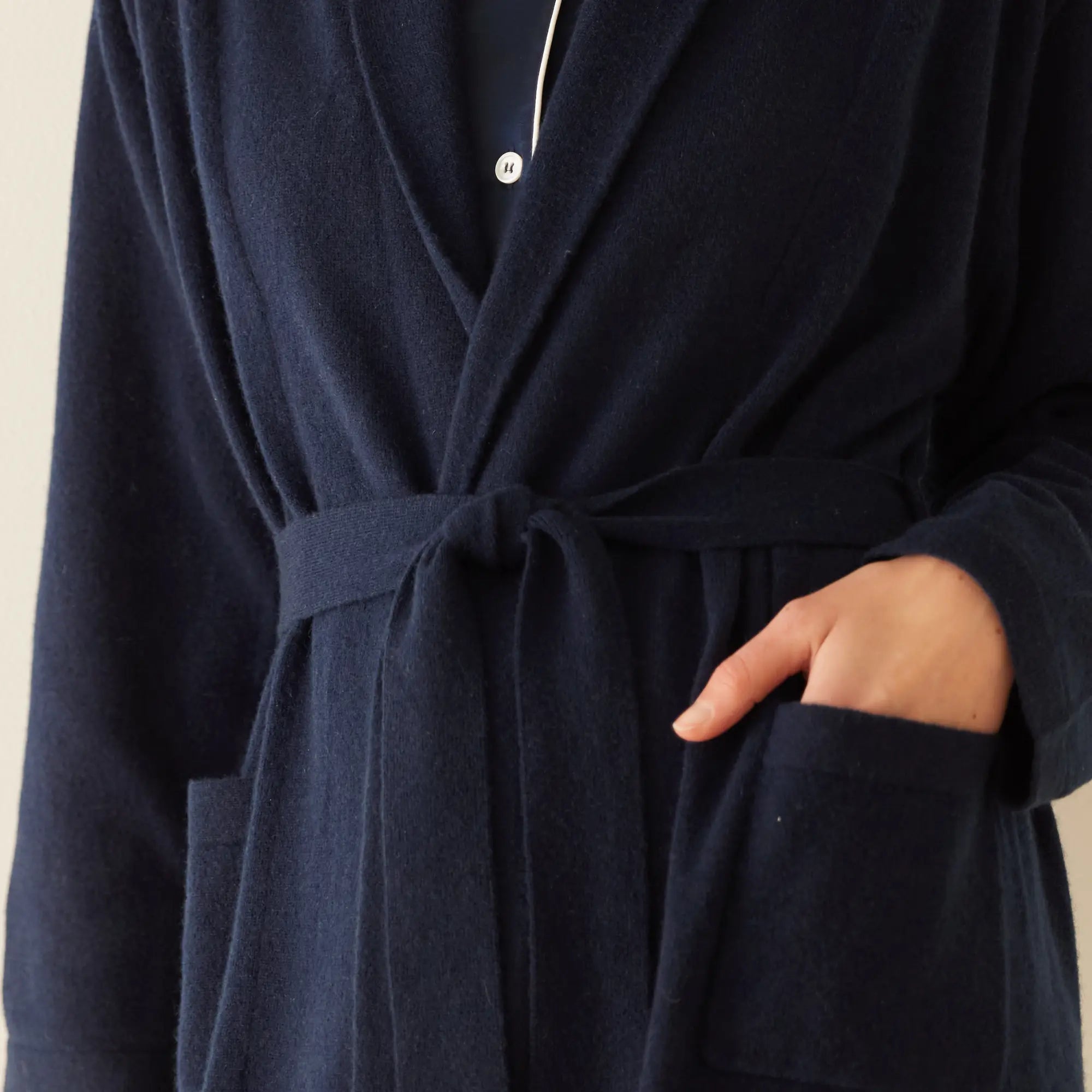
How to recognize quality cashmere? The simple guide
Cashmere is often presented as an exceptional material.
However, not all cashmere is created equal.
Some pill after the first few wears.
Others lose their softness or shape after one season.
So how do you recognize truly quality cashmere, the kind that lasts, that warms without stifling, and that justifies its price?
Here is a simple guide to understanding the essential criteria — without marketing jargon.
1. The #1 criterion: fiber length
This is the most important point, yet the least often explained.
Good cashmere is made of long fibers.
The longer the fiber, the stronger, softer, and more durable the yarn.
Conversely:
-
short fibers are cheaper,
-
they break more easily,
-
they cause pilling.
Quality cashmere pills little, and especially less and less over time.
This is why fiber length is much more crucial than the number of plies or marketing promises.
2. Knit density: a key visual indicator
Good cashmere is neither too thin nor too loose.
When you hold the garment:
-
the fabric should have body,
-
without being rigid,
-
or transparent.
A knit that is too light may feel soft at first touch, but it will often be fragile.
Conversely, a well-worked density guarantees:
-
better insulation,
-
an elegant drape,
-
superior longevity.
Density is a sign of textile integrity.
3. Fiber fineness: beware of misconceptions
We often talk about "microns" to describe the fineness of cashmere.
But this number alone is not enough.
Very fine cashmere made of short fibers can be:
-
soft at first,
-
but unstable over time.
True quality comes from the balance between:
-
fineness,
-
length,
-
and fiber regularity.
Good cashmere is soft, but also stable.
4. Organic cashmere: what really changes
Organic cashmere is not just about the absence of chemicals.
It implies:
-
controlled herd sizes,
-
preserved pastures,
-
a respected natural rhythm,
-
more stringent fiber selection.
Result:
-
often longer fibers,
-
more uniform softness,
-
a more durable material.
Organic cashmere is rarer, slower to produce, and generally of higher quality.
5. Why some cashmere pills quickly
Pilling is not always an immediate defect.
It may appear slightly at first, then stabilize.
But cashmere that:
-
pills a lot,
-
constantly,
-
and quickly loses its smooth appearance,
is often made of short or poorly spun fibers.
Quality cashmere improves with time.
Poor quality cashmere deteriorates.
6. How to test cashmere at home
A few simple actions can give you an idea:
-
Gently crinkle the fabric: it should return to its shape.
-
Rub gently between your fingers: it should remain soft.
-
Observe the surface: too many loose fibers = short fibers.
-
Check the weight: good cashmere is light but substantial.
These tests do not replace expertise, but they provide good clues.
7. Why the Maison CÉTOILE cashmere kimono meets these criteria
At CÉTOILE, the choice of cashmere is based on:
-
long fibers, selected for durability,
-
worked density, for warmth and shape retention,
-
organic fiber, respectful of the material and time.
The kimono is designed as a durable indoor piece:
-
enveloping,
-
soft,
-
elegant,
-
and designed to last through winters without deteriorating.
In summary
Recognizing quality cashmere is not about looking for a superlative or an immediate promise. It's about understanding the balance between long fibers, the right density, and stable softness—choices that make a difference over time.
At Maison CÉTOILE, we prioritize organic cashmere designed to last, soften, and accompany daily gestures without ever imposing itself. Because a beautiful textile doesn't just seduce at first touch: it reveals itself, season after season.
Discover the Maison CÉTOILE organic cashmere kimono → Midnight Blue Eclipse