

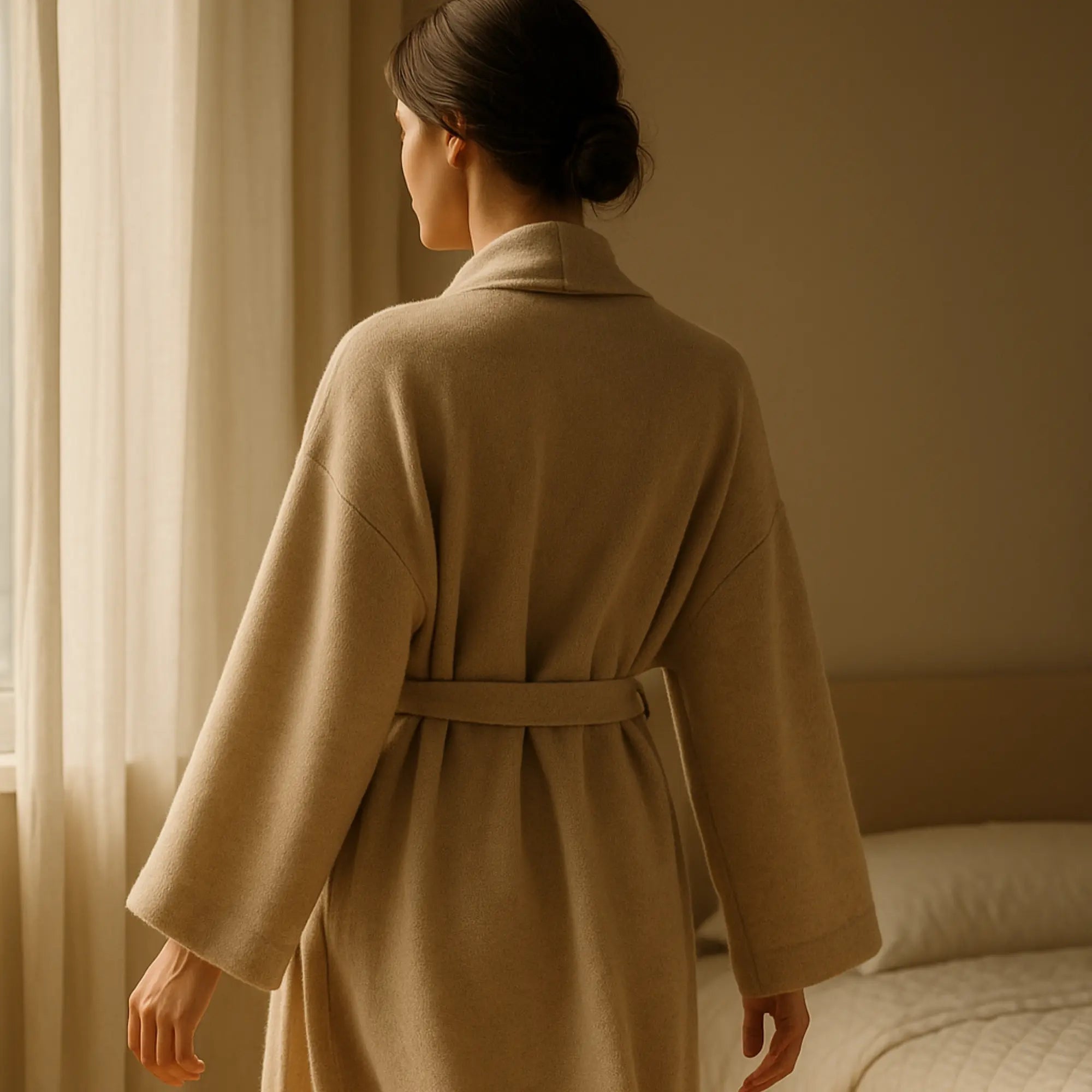
Organic cashmere: why is a kimono so expensive — and so precious?
Some materials brave winters like talismans: fibers that don't seek to impress, but know how to envelop, soothe, and warm without ever suffocating.
Cashmere is one of these rare materials. And when it is organic, respectful of the earth and the rhythm of animals, it becomes one of the most sincere expressions of conscious luxury.
At CÉTOILE, we chose to make it into a kimono. A soft, silent, enveloping winter piece—a garment that doesn't shout luxury, but whispers it.
1. Why an organic cashmere kimono?
Because winter luxury begins with a gesture of warmth**
The kimono is a unique form: universal, simple, almost architectural. It slips on effortlessly, envelops without constraining, and soothes both evening and morning.
In a fabric as noble as organic cashmere, this form becomes a true sanctuary.
Organic cashmere provides three essential things:
• Unmatched warmth
Warmer than wool while being much lighter, cashmere diffuses a gentle warmth that never overburdens the body. It's a comforting warmth—not overwhelming.
• Soothing softness
Organic cashmere is made of very long fibers, even finer than in industrial production. The result: a delicate touch, a second-skin feel.
• A breathable material
Unlike synthetic materials, cashmere allows air to circulate, regulates temperature, and prevents overheating.
In a winter where we seek more calm than performance, a cashmere kimono becomes an everyday companion.
2. Why is cashmere so expensive?
Because it is naturally rare. Irremediably.**
That's the question everyone asks.
And it's a legitimate question.
Cashmere comes from the down—the undercoat—of goats raised on the high plateaus of Mongolia and Central Asia. This down is not shorn: it is delicately hand-combed during the spring molt.
Each goat produces:
-
150 g of raw down per year,
-
which becomes 50 to 70 g after sorting and cleaning.
To make a single kimono, the down of 2 to 3 goats is needed.
And all this only once a year.
The price of cashmere therefore simply reflects what it is:
a rare, slow, patient material, resulting from a human and not an industrial process.
In addition to this:
-
fiber sorting (length, fineness, clarity),
-
very fine spinning,
-
dense knitting,
-
and a constantly increasing global demand.
Cashmere is not expensive "to be expensive."
It is expensive because the material itself is rare—and limited.
3. Cashmere or wool: what's the real difference?
Both materials come from different animals and do not have the same uses.
Wool (sheep):
-
thicker fiber,
-
heavier,
-
more resistant,
-
sometimes a little coarse,
-
warms well but can be itchy.
Cashmere:
-
ultra-fine fiber (14–16 microns),
-
unmatched softness,
-
3 times warmer at equal weight,
-
extremely lightweight,
-
never itchy,
-
enveloping and second-skin feel.
→ From a sensory point of view, cashmere belongs to another category:
that of rare materials that combine warmth, lightness, and fineness.
4. Merino or cashmere: which is warmer?
This is a very common question—and very simple to answer.
Merino wool is excellent: fine, soft, breathable.
But it remains wool.
Cashmere, on the other hand:
-
insulates more,
-
retains heat better,
-
weighs less,
-
warms up faster.
At equal thickness, cashmere is warmer.
This is why it is preferred for winter cocooning pieces rather than technical garments.
For an enveloping garment, designed for evening comfort:
cashmere is unbeatable.
5. Cashmere capital: a fragile resource that must be protected
What very few consumers know is that cashmere has a high environmental cost when produced without control.
Excessive demand leads to:
-
overgrazing,
-
desertification of land,
-
soil depletion,
-
decrease in quality,
-
stress for animals.
This is why organic cashmere exists:
to limit the impact and preserve the material in the long term.
Organic cashmere requires:
-
smaller herds,
-
preserved pastures,
-
a natural growth rhythm,
-
full traceability,
-
strict controls on breeding conditions.
Result:
✔ a longer and finer fiber
✔ superior softness
✔ less pilling
✔ quality that lasts over time
Cashmere capital is fragile.
Choosing organic means protecting it.
6. Why is a CÉTOILE organic cashmere kimono a sound investment?
Because it's not a trend.
It's a piece that lasts for years.
Our choices:
• A long, organic fiber, selected for durability
Less pilling, more softness, better aging.
• Engineered density
A balance between warmth and lightness: comfortable without being heavy.
• A timeless kimono cut
To wear at home, on weekends, for winter cocooning.
• A piece that replaces five others
Good cashmere can be worn for:
cool mornings, quiet evenings, reading, coffee, evening rituals.
• A slow approach to luxury
Create less, but better.
Choose materials with a soul.
Offer pieces that never shout their value, but suggest it.
Conclusion
A warmth that cannot be explained—it is felt**
Organic cashmere is not just a material.
It's a way to get through winter:
more gently, more slowly, more consciously.
A cashmere kimono is a gesture.
A way to bring calm where everything moves too fast.
A piece that warms without weighing, that lasts without imposing.
A precious piece—worthy of winter.